The place - Thessaloniki
One of the more interesting cities to visit in Greece,
Thessaloniki combines successfully the bustling city offerings of the
second largest city in the country, 1.5 million people, with a more
cultural, artistic, gourmet and historic character.
A metropolitan hub and a collection of peculiar corners you will enjoy
discovering. Wonderfully easy to see on foot - most things you would
like to visit you can walk to, if you're
staying in the centre.
Thessaloniki is one of the oldest cities in Europe.
However, its history is experienced in a more subtle way than, for
example, the obvious visiting of the Acropolis in Athens. There are a
great number of historic and
archaeological sites dispersed in the city, but we would say that
most importantly, its heritage is found in the sophisticated and
slightly puzzling character of its inhabitants.
Because of its strategic position and importance Greeks often refer to
it as the “co-capital” of Greece. Indeed, it is a most important
commerce and culture center. The
Helexpo International Trade Fair held in
September, is a showcase for
technology and business activity from many countries (but also a funfair
for adults and children alike).
The
Thessaloniki International Film Festival held in November is one of
the principal film festivals in Europe, that brings interesting and
glamorous crowds to its premieres.
One of the things that give Thessaloniki is distinct character is its
long and wide waterfront. Stretching from the harbour to the White Tower
(the "Palia Paralia" = Old Beach), all the way to the east part of the
city and beyond, it is the delight of locals, as well as visitors, who
can be seen strolling at any time of day (or night), in any weather
conditions. The coastal road is opportunely strewn with cafes, some of
great style and fame, that provide just the right atmosphere to pause
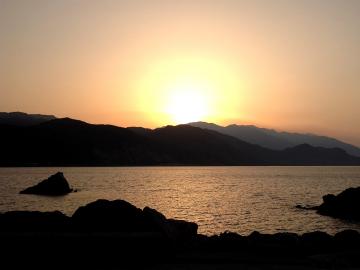
your walk, enjoy perhaps a beautiful sunset (the sun sets over the sea, affording many such
opportunities) while sipping your moccacino or greek coffee.
Weather
Situated in northern Greece, Thessaloniki often has a few degrees lower
temperature than Athens or southern Greece and more humidity. Evenings,
even in the summer, can be cool. In the fall, a fog can shroud the city
in a veil of mystery, a reminder of legendary photos of Thessaloniki in the mist and Theo Aggelopoulos' movies
that were shot here. Summer is hot, up to 30 or more
degrees. However, heat-waves are quickly swept away by the northern "Vardaris"
wind that blows every now and then and refreshes the city's air.
A taste of history
Thessaloniki (or Salonica, as it is also known) is 23 centuries old. It
was founded 315 B.C. by king Kassandros, named after his wife,
Thessaloniki, who was Alexander the Great’s sister. It soon became the
glorious capital of Makedonia and a
commercial and cultural centre for the Balkans.
In 168 B.C. The Romans made Thessaloniki the capital of the Roman
province of Makedonia and the southern Balkans. The construction of the
famous "Via Egnatia" (that connects the "East" to the "West", which is
being revived as an active route today), together with the city's
port, contributes to Thessaloniki's expansion and affluence.
With the founding of the Byzantine Empire in 395 A.D., Thessaloniki was
pronounced "co-regent" with Constantinople.
The city acquired a Byzantine character which it has maintained to the
present day, with more (and more significant) Byzantine monuments than
any other city in Europe.
In 1430 it was occupied by the Turks and claims an important role in the
Ottoman Empire, which its strategic position and power guarantee.
In 1912 the city was liberated by the Greek army on the feast day of its
patron saint, Agios Dimitrios.
By plane:
Fly to "Makedonia" airport in Thessaloniki (or Salonica), code: SKG. It
is a modern, modest-size, easily navigable international airport, about
16 km east of the city centre. It serves both scheduled and charter
flights.
Airport telephone: 2310-473977, 473720 (24-hour flight information),
2310-473312, 473212 (switchboard).
Access to the city is straightforward, taking 20-30 minutes by car
or taxi.
A taxi to the centre would cost approximately 11-15 euros, depending on
on amount of luggage and traffic in town.
You can pick up a taxi at the taxi rank outside arrivals or call a
radio-taxi (simple call costs 1.50 euros, appointment costs 2.30 euros).
Radio-taxi telephone numbers:
2310-550500, 214900, 546522, 551525 866866, 525000.
Bus number No78 runs between the airport and the railway station (west
of the centre), through the centre. Departs every 1 hour. Cost of
ticket: 0,50 €. Journey time: about 40 minutes to the centre, 50 minutes
to the railway.
British
Airways has daily flights to Thessaloniki from London
Gatwick. Prices start from 200 euros for a return ticket.
Tel: 801-11-56000 (Greece), 0870-850-9850 (UK).
NEW:EasyJet starts low cost direct flights to Thessaloniki from London Gatwick from 30 January 2008. 3 flights a week in the winter, increasing to 4 flights a week in the summer months.
Easyjet also flies toThessaloniki from Dortmund Germany.
Tel: 210-353 0300 (Greece), 0905 821 0905 (UK).
Flying from Athens:
Flight takes about 40 minutes. One way tickets cost
65-75 euros (including taxes).
The 2 domestic airlines are Aegean and Olympic - choose Aegean for
better service and on time record.
Aegean Airlines, airline
website/e-tickets, tel: 801-11-20000 or 210-9988300.
Olympic Airlines,
airline website/online reservations, tel : 801-11-44444 or 210–9666666.
By ferry:
The Minoan Lines "Deadalus" ferry connects Thessaloniki to Crete,
Santorini and other islands in between.
See the schedule on our website.
By bus:
Connected to most cities in Greece by KTEL (long-distance) buses.
By train:
The InterCity line from Athens is a fast, reasonably comfortable
(and romantic!) way to travel to Thessaloniki.
Information: Hellenic Railways (OSE),(click
"EN" for English on top-right of homepage). Tel: 1110 (Customer care) or
210-5297777, 5297313. You can order tickets by phone and pay them by
credit card. First class costs 47-84 euros (worth the extra).
Journey takes 4 hours and 15-30 minutes with InterCity Express trains, 5
hours 15 minutes with InterCity trains.
Thessaloniki is connected by train also to some other cities in Europe
like Vienna, Budapest, Belgrade (Beograd), Sofia, Moscow, Ljubljana.
Also, to Constantinople (Istanbul) with a new overnight sleeper train
(11 hours and 30 minutes).
By car:
Distance to Athens: 506 km (about 4.5 hours drive time).
Most part of the road is a high-speed motorway, but there are several
narrow and winding stretches you must watch out for.
You want to be in the centre, be able walk to most
places of interest (and to the famous cafes, bars & restaurants of
Thessaloniki!), but have a quiet room in a lively, but not too noisy,
location.
We have selected the perfect candidates for your stay. Two interesting
small hotels, in historic buildings, right in the heart of Thessaloniki.
Capsis Bristol Hotel, at the
beginning of Ladadika district, is the charming and luxurious
option, with old-time finesse and authentic interiors - as well as
exterior, spacious and comfortable rooms & suites, delightful atrium
breakfast hall & cafe. 20 rooms. Prices are from 222 to 300 euros/night
(2 people).
Capsis Bristol Hotel - review,
photos, rates & reservations with SuperbGreece.com.
Luxembourg Hotel, near Aristotelous
square, also offers the experience of staying in a historic, handsome
building, but with more standard interiors and lower prices. 36
rooms. Prices are from 100 to 156 euros/night (2 people).
Luxembourg Hotel - review, photos,
rates & reservations with SuperbGreece.com.
Around the city streets
Ladadika district - this was the only part of the town to survive the 1917 fire. It used to
serve as a storage and trading place for olive oil. Today it is an
entertainment focal
point with many traditional or gourmet restaurants and lively bars and
cafes. Buildings have been beautifully restored. Located a
little after Eleftherias Square (bottom of Venizelou str.).
The
Modiano Old Market, the lively bazaar of mostly meat and fish, around
which are quaint tavernas. In the evening, the is a cafe-bar on the 1st floor overlooking the market
- with wonderful music and pop art.
Outside the Modiano market are the "Louloudadika", the flower shops,
that
occupy and give colour and aroma to a corner of the pedestrian street.
Vas. Irakliou & Komninon street (staight up from Luxembourg Hotel).
Interesting squares and corners (always with cafes and restaurants to
delight): Kalapothaki pedestrian (between Venizelos
and Aristotelous Square), Athonos square, Aristotelous squares, Navarinou
square, Gounari pedestrian.
Beyond the centre (taxi or bus from Eleftherias square), is the "Ano
Poli" or "Kastra" (the upper city or castles). Worth visiting for the
ruins, the stunning views and again the excellent small tavernas. Strewn
with protected 19th century houses -
beautiful.
The White Tower & museum
"The" landmark of Thessaloniki, a 15th century Venetian circular tower,
on the waterfront, in the heart of the city, built to form part of the shore defense system.
The Ottomans used it as a place for the execution of janissaries
(children abducted by the Turks and raised to become of the fiercest
Turkish warriors) – which is why it became known as the “tower of blood”.
Today, it is named “White Tower” because of its (now faded) white color:
King George ordered it to be painted white in 1912, when the city was
freed.
Used as an exhibition space by the Byzantine Museum.
Great views from the top, and a small coffee shop.
Opening Times: Tuesday-Sunday: 08.00-14.30, Monday: closed
The Archaeological Museum of Thessaloniki
Exhibits findings from northern Greece - in particular,
prehistoric findings from Makedonia and Thrace, as well as
art
of the Archaic and Classical Periods. Remarkable finds from the tombs at Derveni.
Finds from the excavation of the cemetery at Sindos (rich
in gold finds). The large number of gold items is unique for this
period. Also: Roman sculptures, glass vases, mosaic floors.
Address: Manoli
Andronikou 6 (in the centre, opposite the Helexpo entrance). Tel:
2310-830538.
The Museum of Byzantine civilization
One of the largest and most significant Byzantine museums in the world.
It houses permanent and temporary exhibitions
and operates as a center for the investigation and study of the
Byzantine culture. The museum's collection consist of sculptures,
frescoes, mosaics, wall paintings, icons, coins, manuscripts, minor art,
tombs, jewelry, clay vessels and glassware. The three permanent
exhibitions are: Early Christian Period (design and
decoration of churches, cities and dwellings), the Middle Byzantine
Period and Late Byzantine Period. Address: 2 Stratou Avenue (near the
University, walkable from the centre). Tel: 2310-868570.
The church of Agios Dimitrios
The largest church in Greece. Dedicated to Saint Dimitrios - the
patron of the city. The original church was built in 313 A.D. The church has been re-built
twice, as twice
before it was destroyed, in 1917 and 1949. Visit the crypt or
“Martyrion” of Saint Dimitrios, which was discovered beneath the
altar and the flaps. It includes items that survived the fire and those
found in recent excavations. A chapel of St. Euthymios is attached to
the south-east corner. This church is situated on Agiou Dimitriou street
(north-west of the city). Perhaps a taxi ride, if a long walk is not
desirable.
The church of Agia Sofia
Of sizeable proportions and different style, rectangular, covered with a
dome. Built in the 7th century.
Was burnt by fire, converted to mosque and is now a functioning Orthodox
church again, as well as a monument. On Agias Sofia square, in the
centre.
The Arch of Galerius
Another city landmark, known simply as the “Kamara” (arch). Built in 305 A.D. to
celebrate the triumph of the Emperor over the Persians. Today only part of the
monument stands (3 pillars and part of the masonry above). Pillars are covered with sculpted marble slabs, which show the wars of Galerius against the Persians.
The Ancient Forum
This was the centre of ancient Thessaloniki. Was
built on the site of an older forum, dating back from early Imperial
times.
Ataturk Museum
Interesting, small museum. The founder of modern
Turkey – Mustafa Kemal Ataturk - was born (in a room on the 2nd floor
which is also the most interesting to see) in 1881 in this
house on Apostolou Pavlou Street. Address:
75 Apostolou Pavlou Street, centre. Tel: 2310-248452. Opening times:
Daily 10.00-17.00 (we suggest you call & check times).
There are numerous other museums in Thessaloniki: the Jewish
museum, Cinema museum, museum of Contemporary Art, Technology museum of Thessaloniki, museum of Photography,
museum
of Design, museum of Ancient, Byzantine and Post Byzantine Musical
Instruments, Folk Art and Ethnological museum of Makedonia and Thrace
and many more!
Special:
Thessaloniki International Film Festival
Held in November each year, lasts 10 days. Features: current
productions - including world premieres of notable movies - and tributes to
great filmmakers. The festival is held mainly at the historic Olympion cinema,
a beautiful building, worth visiting out-of-festival season for the
lovely cafe upstairs ("Domatio me thea" = Room with a View) with fine
views across Aristotelous square to the sea. The film festival brings a colourful, multi-cultural and multi-lingual
crowd to the city that becomes even livelier and more cosmopolitan
during that time.
Special Comments -
Thessaloniki
If you are visiting Thessaloniki during the
Helexpo Fair (September)
or the Film Festival (November), take care to book your room long in
advance - the city's hotels become full. Also, bear in mind that stays of only 1
or 2 nights may not be accepted by hotels during these periods.
Top of page
|

Cultural and cosmopolitan feel, waterfront walks, museums, gourmet
restaurants, quaint corners. Greece & Orient combined.
|
|
|
Aristotelous square
|
|
|
Coastal road
|
|
|
Waterfront &
White Tower
|
|
|
Ladadika district
|
|
|
Thessaloniki centre
|
|
|
Quaint street
|
|