The place - Makedonia
Makedonia (or Macedonia, as it may also be spelled) is
the central region of northern Greece.
It is most famously associated with the kings Philip and his son
Alexander the Great, who made Makedonia the most powerful empire in
ancient times, stretching its reach all the way into Asia and spreading
the Greek culture and language to the peoples of that area.
The birthplace also of Aristotle, the great philosopher who set the
foundations of logic, making our world rational and introducing
many of the western ideas we now cherish. He studied the nature of the
world and also made major advances in the fields of physics,
meteorology, natural history & biology, as well as chemistry.
Today, Makedonia is a vibrant and distinct part of
Greece. With its capital, the cosmopolitan
Thessaloniki, having the
lead, it includes many diverse, both culturally and geographically areas
and towns: Serres, Drama, Kavala, Katerini, Halkidiki (and Mount Athos)
Kilkis, Edessa, Veroia, Kozani, Kastoria, Grevena and Florina.
Largely undiscovered by tourists, it has an amazing number of
attractions to offer and interests to pursue: Stunning nature (rivers,
lakes, gorges, ski resorts and mountains such as Olympus), numerous significant
archaeological sites like Vergina, Pella and Philippi, Byzantine relics
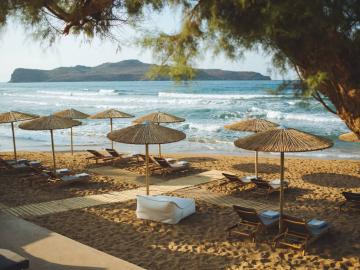
and churches everywhere, crystal clear sandy beaches in Halkidiki,
gorgeous mountain villages with some beautiful guesthouses. For those males
(only!) who quest spirituality or simply spectacular natural beauty,
Mount Athos with its ancient monasteries is worth a visit.
A taste of history
Makedonia first appeared as a geo-political entity in the 7th century
B.C, when the ancient Greek tribe of "Makedones" established their
presence in the area.
For many centuries Makedonia, largely because of its geography, remained
on the fringe of the Greek world. The entry of the Makedonian city-state
into the history of southern Greece was sealed by the acceptance of
Alexander I, king of Makedonia, by the "hellanodikai" as a competitor in
the Olympic Games in 496 B.C. (only Greeks were allowed to participate
in the games). Alexander I, called Philellinas (grecophile), was the
first great leader of Makedonia. His timely information about the moves
of the Persian armies of Xerxes and Mardonios was paramount to their
defeat.
In 359 B.C., with the accession to the throne of king Philip II (Filippos),
a new glorious era begun. From an insignificant, marginal state, the
charismatic Philip transformed Makedonia into a dominant power in the
Aegean and paved the way for his son's campaigns in the Orient. Philip's
vision had the result of ushering the ancient world into the epoch of
Hellenism, spread in three continents. His ingenious reforms of his army
and talent in strategy left his son, Alexander the Great (Megas
Alexandros), with a magnificent heritage and sphere of dominance to
preserve. He proved more than worthy of his father's inheritance, as
well as his professor's, Aristotle's, teachings. He went where no Greek
had ever gone before, to the ends of the then-known world, defeating the
mighty Persians and establishing his reign as far as India. His
celebrated victories, genius and passion, as well as the dissemination
of greek spirit and civilization he nurtured and accomplished, made him
into an timeless legend.
After his death in 323 B.C., the Makedonian empire declined, and
eventually fell to the rule of the Romans who made
Thessaloniki the capital of the Roman
province of Makedonia and the southern Balkans. They built the
illustrious "Via Egnatia", the road that connected the
Byzantium to Rome.
Makedonia's growth and prosperity resumed in the Byzantine era (4th-5th
century A.D.). Its strategic location at the crossroads of the major
roads in the Balkan peninsula, its important ports of Thessaloniki and
Kavala brought wealth and a flourishing of art and commerce.
With the collapse of the Byzantine empire, Makedonia passes to Frankish
and then to Turkish (Ottoman) rule.
During the Ottoman reign (15th-early 20th century), local autonomy of
some areas, in combination with the Greeks regaining control of trade
and production, after the dust of the conquest had settled, allowed the
continuance of the region's prosperity. Even though southern Greece's
liberation started in 1821 with the Uprising in the
Peloponnese against the
Turks, it was not until 26 October 1912 and after a long and bloody
Makedonian Struggle that Makedonia became free and reunited with the
rest of Greece.
How to get there - Makedonia
Arrive at Thessaloniki:
The biggest airport is the "Makedonia" international airport in Thessaloniki (or Salonica), code: SKG.
You can also drive, take the train or bus to Thessaloniki, depending
where you're coming from.
See details about
how to get to Thessaloniki.
Other airports in Makedonia:
Kavala, code: KVA
Kastoria, code: KSO
Kozani, code: KZI
Where to stay - Makedonia
In Thessaloniki:
We have selected for you two beautiful small hotels in the centre.
See hotels in Thessaloniki for
review, photos, rates & reservations with SuperbGreece.com for these 2
hotels.
In Kavala:
A destination in its own right: the exquisite, luxurious
Monument-hotel Imaret.
A cabin in the mountains, great nature and views:
Dasiko Horio.
In Drama:
Near Falakro ski centre, a small hotel with mountain lodge feel:
Granitis Hotel.
We are happy to see many small hotels worthy of note spring up in
exciting areas of Makedonia...we will give you more of them soon, as we
discover, inspect and review them.
What to see/do - Makedonia
First stop is
Thessaloniki, the bustling and historic capital.
Some of the many sights you may visit further afield:
Petralona Cave and Anthropological Museum
40 km south-east of Thessaloniki, in Halkidiki. With many impressive stalagmites and stalactites
and the chamber where the Archanthropus (archaic Homo sapiens) skull was found. The skull is 700000 years
old, belonging to the oldest known
European man. Fossils of extinct animals like lions, hyenas, bears,
elephants, panthers, rhinos and 25 different species of birds we also
found here.
Opening hours: 09.00-before sunset.
Tel: 23730-71671.
Archaeological site of Vergina
70 km west of Thessaloniki.
Vergina was the ancient city of Aegae, the first capital of the Kingdom of Makedonia.
It lies on the slopes of the Pierian Mountains.
Discovered and excavated by the renown archaeologist Manolis Andronikos.
What you will see: The royal tomb of king Phillip II (Alexander the Greats father).
The Palace and the Theatre (with a fine mosaic floor), the Temple of Eukleia,
the acropolis and city walls and
the burial ground with more than 300 tumuli some dating back to 11th century B.C.
Tel: 23310-92347.
The Archaic Cemetery of Sindos
20km west of Thessaloniki.
121 tombs have been excavated. They all contained rich offerings: vases, bronze vessels,
shields, iron, weapons, bronze helmets, gold and silver jewelry.
Kavala
A beautiful city by the sea, with a port, a castle and many museums and
archaeological sites nearby. See Kavala
feature.
Drama
A not so well known town of quiet, local character - with some surprises
like its parks with marble sculptures and a claim to international fame
due to its Short Film festival.
Other attractions: Archaeological Museum,
Fort Lisse at Ochyro, the Falakro ski centre.
Pella
30 km north-west of Thessaloniki.
The capital of the Makedonia kingdom for 250 years (from 400 B.C.).
Noteworthy archaeological site and museum.
Halkidiki (or Chalkidiki)
Three peninsulas, or as the locals call them, three "fingers".
Some of the most spectacular, inviting beaches in Greece. A wonderful
combination of green (trees) and blue (sea). Busy resorts, but also
quieter gems. And - history and culture in the old villages inland.
Apart from the Petralona cave and museum mentioned above, the History and Folklore Museum at Arnaia,
is worth a visit.
Mount Athos ("Agion Oros" = Holy Mountain)
The only place in Greece, completely dedicated to prayer and
worship. It is a self-governed part of the Greek State. It occupies the entire third, eastern peninsula of Halkidiki - called
the peninsula of Athos (after the mountain). It is about 50km in length, 8-12km
in width. It is the center of Eastern
Orthodox Monasticism. The scenery and natural beauty is stunning. The 20
ancient monasteries perched in the slopes of the mountain are each of
distinct architecture (some bearing the character of another Christian
Orthodox country such as Russia or Serbia and hosting monks from there).
The many artifacts and monuments of religious, national and artistic
value are priceless.
Rumor has it that many of the earth's "top men", from industrialists to
world leaders, visit Mount Athos from time to time to recapture their
internal peace in its peaceful and spiritual atmosphere. Perhaps our top
man will one day visit and let you know the inside story!
Caveat: ONLY men are allowed to visit Mount Athos, as it is a
male-monks only territory. Men must call a few days
before their visit to make arrangements as official documents are needed to visit.
Tel: 2310-252578, Fax: 2310-222424.
Only 100 men can visit per day. Visitors can go by road as far as
Ouranoupoli. Distance is about 140 km from Thessaloniki. No visitors can
take cars to Agion Oros, so they must be prepared for long walks.
Special Comments - Makedonia
A bowl full of fruit for any interested, discerning
traveller. Relatively undiscovered - but a region worth a trip in its own
right. Easy access directly to Thessaloniki or from Athens. Onward travel
to Istanbul can make a twin centre holiday of the most fascinating and
memorable variety for you.
Simple map - Makedonia
We have drawn an overview map of Makedonia, to
give you a better idea of where things are. See the
Makedonia map.
Top of page
|

Rich in history as anywhere in Europe, the homeland of Alexander the Great, has also incredibly
diverse geography, nature & culture. A gem to be enjoyed and discovered by
discerning visitors.
|
|
|
Philippi ancient site
|
|
|
Falakro mountain
|
|
|
Lion of Amphipolis
|
|
|
Kavala
|
|
|
Thessaloniki - Ladadika
|
|
|
Paggaio mountain road
|
|